The world is changing faster than most people realize. Across continents, nations are quietly entering a demographic crisis that could reshape economies, cultures, labor markets, education systems, healthcare, and even global power itself. The latest mapped fertility rate data paints a shocking picture: birth rates are collapsing almost everywhere, and humanity is entering an era no civilization has ever experienced before.
For decades, experts warned the world about overpopulation. Governments feared crowded cities, food shortages, rising pollution, and resource depletion. But now the narrative has dramatically reversed. Instead of too many births, countries are struggling with too few babies. The global fertility decline is no longer a future prediction. It is happening right now, and its effects are already visible in schools with empty classrooms, shrinking workforces, aging populations, rising economic pressure, and communities slowly losing their younger generations.
This is not just a statistical trend. It is a social earthquake.
The average fertility rate needed to maintain a stable population is around 2.1 births per woman. Yet dozens of countries have already fallen far below that replacement level. Nations once known for massive population growth are now facing dramatic slowdowns. Some are even projected to lose millions of people within a single generation.
Countries in East Asia are among the hardest hit. South Korea continues to record some of the lowest fertility rates ever documented in human history. Japan’s aging population has become a global warning sign. China, after decades of strict population control policies, is now struggling to encourage families to have children again. Even wealthy European nations are experiencing sharp demographic declines despite advanced economies and modern lifestyles.
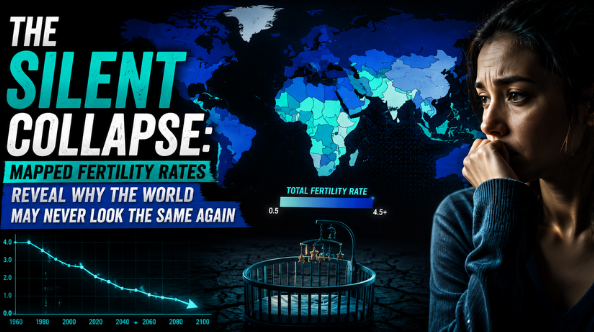
The map of global fertility rates tells a powerful story. Regions once filled with rapid population growth are beginning to slow down, while many developed nations are entering population decline at alarming speeds. The implications are enormous.
Fewer births mean fewer workers in the future. That directly affects economic growth, innovation, tax systems, pensions, healthcare support, and national productivity. Entire industries may face worker shortages. Governments could struggle to support aging populations as the number of retirees rises faster than the number of young taxpayers entering the workforce.
But the crisis is not only economic.
At its core, declining fertility reflects a deeper transformation in how modern society functions. Rising living costs, expensive housing, unstable job markets, student debt, career pressure, delayed marriages, mental stress, and changing cultural values are pushing millions of young adults away from parenthood. Many people simply feel they cannot afford children anymore. Others fear bringing children into an uncertain future shaped by economic instability, climate anxiety, and social pressure.
In many cities around the world, young couples are trapped between ambition and survival. They work longer hours than previous generations yet often struggle to build stable financial foundations. Parenting has become emotionally and financially overwhelming for many households. The dream of starting a family now feels out of reach for millions.
This shift is changing societies from the inside out.
Schools in some regions are shutting down due to declining student numbers. Rural towns are losing younger generations entirely. Businesses are competing for smaller pools of workers. Healthcare systems are under pressure as elderly populations expand. Governments are launching emergency policies, offering financial incentives, tax benefits, childcare support, and extended parental leave in desperate attempts to reverse the trend.
Yet many policies are failing to create meaningful change.
Why?
Because fertility decline is not caused by one single issue. It is connected to modern lifestyles, economic realities, emotional exhaustion, housing insecurity, changing priorities, and social evolution itself. Throwing money at the problem is not always enough. People need stability, hope, time, emotional security, and confidence in the future before deciding to raise children.
Some experts believe artificial intelligence, automation, and robotics could help offset shrinking populations by replacing parts of the workforce. Others warn that no technology can fully replace the social, emotional, and economic energy created by younger generations. A world with fewer children may become wealthier in some areas but emotionally emptier in others.
Meanwhile, countries with higher fertility rates may gain long-term geopolitical influence. Population size still matters in global economics, military strength, consumer markets, innovation, and political power. Nations capable of sustaining younger populations may dominate the next century.
The fertility map is more than data. It is a warning signal about where humanity may be heading.
If current trends continue, future generations could inherit a world with shrinking cities, abandoned communities, overwhelmed healthcare systems, labor shortages, slower economic growth, and increasing loneliness among aging populations. Some nations may face demographic collapse within decades.
At the same time, this global transition forces humanity to ask difficult questions.
What kind of future are young people inheriting?
Why are millions losing confidence in building families?
Can governments truly make parenthood affordable again?
Will society adapt before demographic decline becomes irreversible?
These are no longer academic discussions. They are urgent global realities.
The countries that respond wisely today may protect their future prosperity tomorrow. Those that ignore the warning signs could face economic stagnation, social instability, and long-term decline. The fertility crisis is not only about population numbers. It is about whether societies can create environments where people feel secure enough to build families, communities, and futures again.
One thing is becoming impossible to ignore: the world’s population story is entering a completely new chapter, and the consequences will impact every generation to come.
People often think global change arrives through wars, revolutions, or technological breakthroughs. But sometimes the biggest transformation happens quietly, through the absence of something that once seemed natural and endless: new life itself.
The map has already revealed the truth.
Now the question is whether the world is prepared for what comes next.